Despite a steady rise in bank deposits across Bangladesh, uncertainty among depositors continues to grow as concerns over liquidity, loan defaults and restructuring of weak banks shake public confidence in the financial sector.
Following the fall of the country’s previous “fascist government,” several sectors of the economy experienced sharp disruptions, placing significant pressure on the overall financial system. The banking sector, in particular, has increasingly been viewed by many customers as unstable and insecure.
Although assurances from authorities about corrective measures have offered some relief, public anxiety has not fully subsided.
According to Bangladesh Bank data, total deposits in the country’s banking sector reached nearly Tk 19.67 trillion by the end of January this year, up from around Tk 17.81 trillion during the same period a year earlier.
Deposits in Islamic banks also increased, rising to approximately Tk 4.76 trillion in February.
However, analysts say the increase in deposits does not necessarily reflect restored confidence.
Many customers are now preferring short-term deposits instead of long-term savings due to uncertainty surrounding the banking sector. Others are dividing their savings among multiple banks to minimize risks.
Public frustration has also surfaced over several troubled banks in recent months. Many depositors have alleged that they are unable to withdraw funds on time or receive expected profits on their savings. In some areas, protests and human chains have been organized by affected customers.
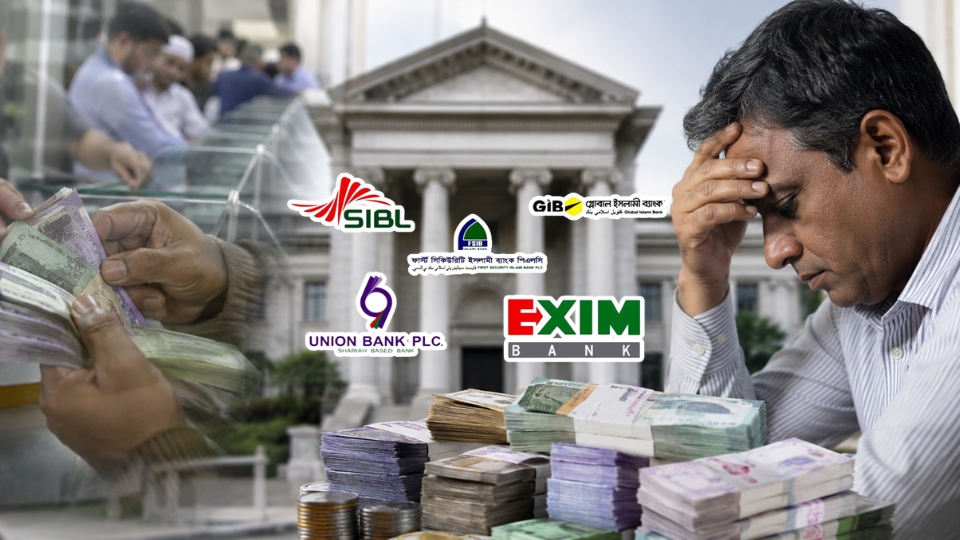
Amid the growing crisis, five Islamic banks, including First Security Islami Bank, Global Islami Bank, Union Bank, EXIM Bank and Social Islami Bank, have been merged to form a new entity named “Combined Islami Bank.”
Bangladesh Bank said the integration process would be carried out gradually. Customers will receive new account numbers and cheque books, and the full transition may take between one and a half to two years.
The merger, however, has added to public concerns, particularly over the safety of deposits and expected returns during the restructuring process.
Sources at the central bank said part of the new bank’s capital would be provided by the government, while some institutional deposits would be converted into capital.
One of the most discussed aspects of the restructuring has been the introduction of the “haircut” mechanism, a globally used crisis-management approach aimed at reducing liabilities by adjusting a portion of deposits or profits.
Bangladesh has also adopted a similar measure.
Authorities have decided not to provide profits on deposits for the years 2024 and 2025 for customers of the five merged banks. Customers who have already withdrawn profits during that period will have the amount adjusted against their deposits.
According to Bangladesh Bank estimates, the move could reduce liabilities by nearly Tk 100 billion.
Economists say that while haircut measures are not uncommon internationally, they represent a major psychological blow for ordinary depositors and reinforce fears that money kept in banks may not be fully secure.
At the same time, the country’s mounting non-performing loans continue to raise concerns.
Bangladesh Bank data shows defaulted loans reached approximately Tk 5.57 trillion by the end of December 2025, accounting for more than 30 percent of total outstanding loans.
Experts say repeated loan rescheduling facilities and the lack of effective action against major defaulters have allowed the real risks within the banking sector to remain hidden for years.
As confidence weakens, many people are shifting away from bank savings and turning to alternative investments. Some are buying gold while others are investing in land or US dollars. Many are also considering government savings certificates as a relatively safer option because bank deposit returns, in many cases, remain lower than inflation.
Economists warn that the banking system fundamentally depends on public trust, and the crisis in a handful of banks is now affecting confidence in the entire sector.
They say restoring stability will require strict recovery measures against loan defaulters, transparent restructuring of weak banks, greater disclosure of financial information and stronger depositor protection mechanisms.
Otherwise, analysts caution, rising deposits alone will not be enough to ease public fears over the banking sector.