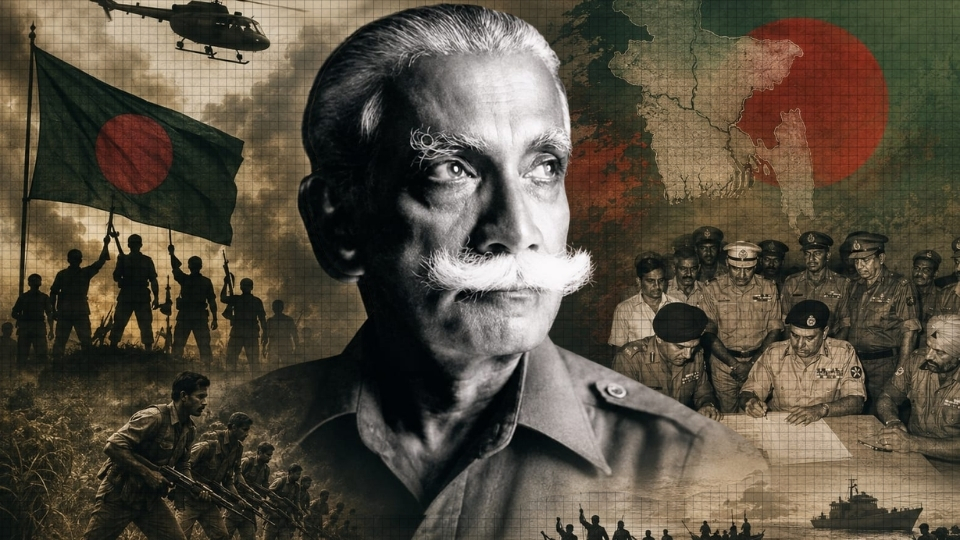
Among the stalwarts whose names remain permanently etched in the history of Bangladesh’s Liberation War, General Muhammad Ataul Gani Osmani stands out as a defining figure. Widely known across the nation as Bangabir (Hero of Bengal), the disciplined military strategist took scattered civilian and paramilitary resistance in 1971 and forged it into an organized fighting force capable of defeating a entrenched conventional army. Today, September 1, marks the 108th birth anniversary of the Commander-in-Chief of the Mukti Bahini and the Bangladesh Armed Forces.
Born on September 1, 1918, in Sunamganj, Osmani distinguished himself from an early age. In 1934, he secured the first position across all of British India in his Matriculation examinations, later completing his higher education at Aligarh Muslim University. In 1939, he joined the British Indian Army, embarking on a storied military career that saw him deployed to the Burma Front during the Second World War.
Following the 1947 partition of India, Osmani was inducted into the Pakistan Army, where he held vital appointments in the General Staff and military operations directorates. He retired as a Colonel in 1967, transitioned to public life, and secured a seat in the Pakistan National Assembly in the historic general elections of 1970.
Taking Command Amid Chaos
When the Pakistan Army launched its brutal crackdown and genocide across East Pakistan in March 1971, the Bengali populace responded with spontaneous armed resistance. While these localized insurgencies were driven by raw courage, the fragmented struggle desperately needed centralized command, tactical coordination, and military discipline.
Osmani assumed that heavy mantle.
In April 1971, at a historic conclave of senior Bengali military officers in Teliapara, Osmani was formally entrusted with the overall military leadership of the Mukti Bahini. Soon after, the newly formed Mujibnagar Government officially designated him as the Commander-in-Chief of the Bangladesh Armed Forces and the Mukti Bahini.
Under his direction, the entire theater of war was divided into 11 operational sectors and multiple sub-sectors. He took direct charge of coordinating regional commands, organizing weapons logistics, setting up systematic training regimens for hundreds of thousands of volunteers, and orchestrating extensive guerrilla strikes deep inside enemy lines.
Osmani recognized early on that engaging a well-supplied, mechanized military in purely conventional combat would prove unsustainable for the nascent force. Instead, he prioritized asymmetric guerrilla warfare. Guided by his directives, freedom fighters systematically targeted Pakistani supply depots, communication links, transport hubs, and strategic outposts. Toward the latter half of the war, he directed the formation of naval commando units and a rudimentary air wing, enabling joint operations across land, riverine routes, and the skies.
The Final Phase and the Absence at Racecourse
After nine months of relentless resistance, the Pakistani forces were thoroughly worn down. The strategic dynamics accelerated on December 3, when direct hostilities broke out between India and Pakistan, formally marking India’s direct military entry into the conflict just 13 days before final victory.
The subsequent joint campaign by Indian and Bangladeshi forces encircled Pakistani formations across East Pakistan, cutting off every escape route. On December 16, 1971, the Eastern Command of the Pakistan Armed Forces surrendered unconditionally.
The surrender ceremony took place at the Ramna Racecourse Maidan in Dhaka. Lieutenant General A.A.K. Niazi of Pakistan and Lieutenant General Jagjit Singh Aurora, the General Officer Commanding-in-Chief of the Indian and Bangladeshi Joint Forces, signed the historic Instrument of Surrender.
However, General Osmani, the supreme commander of the forces that fought for nine bloody months, was not present at the table—an absence that remains one of the most debated and discussed episodes in the nation’s history.
Lieutenant General J.F.R. Jacob, then Chief of Staff of the Indian Eastern Command, later claimed that the helicopter carrying General Osmani had come under fire and sustained damage, preventing him from landing in Dhaka in time for the ceremony.
Conversely, other historical accounts and scholarly analyses suggest that Indian military leadership failed to take adequate initiatives to ensure his presence, with some asserting that his exclusion was deliberate. The absence of Bangladesh’s military chief at the defining visual moment of independence has remained a long-standing point of public regret and frustration within Bangladesh. Group Captain A.K. Khandker, Deputy Chief of Staff of the Bangladesh Armed Forces, represented the country on the podium.
The Nature of the Surrender
The text of the surrender instrument explicitly stated that the Pakistan Eastern Command surrendered all its land, naval, and air forces to Lieutenant General Jagjit Singh Aurora, who was designated as the commander of the joint Indian and Bangladesh forces in the Eastern theater.
While the surrender was formally made to the Joint Command, the operational execution, protocol, and public imagery of the event were dominated by the Indian high command, with Aurora signing on behalf of the victorious forces.
This visual imbalance underscored the significance of Osmani’s absence. Historians frequently observe that having the supreme Bengali commander present at the signing would have provided an indispensable symbolic acknowledgment of the Mukti Bahini’s nine-month sacrifice at the exact moment of triumph.
The Legacy of Bangabir
General Osmani’s enduring legacy rests on his ability to transform raw, dispersed popular anger into a coherent national army under extreme wartime duress. He operated not merely as an administrator issuing orders from headquarters, but as the central planner who balanced frontline combat battalions with widespread guerrilla insurgencies to break the enemy’s will to fight.
On December 26, 1971, following the liberation of Bangladesh, Osmani was elevated to the rank of full General in the Bangladesh Armed Forces. He retired from active military service in April 1972, subsequently serving in the national cabinet and remaining active in domestic politics.
General Osmani died while undergoing medical treatment in London on February 16, 1984. He was laid to rest with full state and military honors near the shrine of Hazrat Shah Jalal (R.A.) in Sylhet.
From an exceptional student in British India to a decorated field officer, and ultimately the supreme military commander of an independence war, General M.A.G. Osmani’s life remains inseparable from the birth of Bangladesh. He was the Bangabir who organized a scattered rebellion into the disciplined force that helped deliver a sovereign nation.
Sources: BSS, Wikisource, Liberation War e-Archive, Rtv online