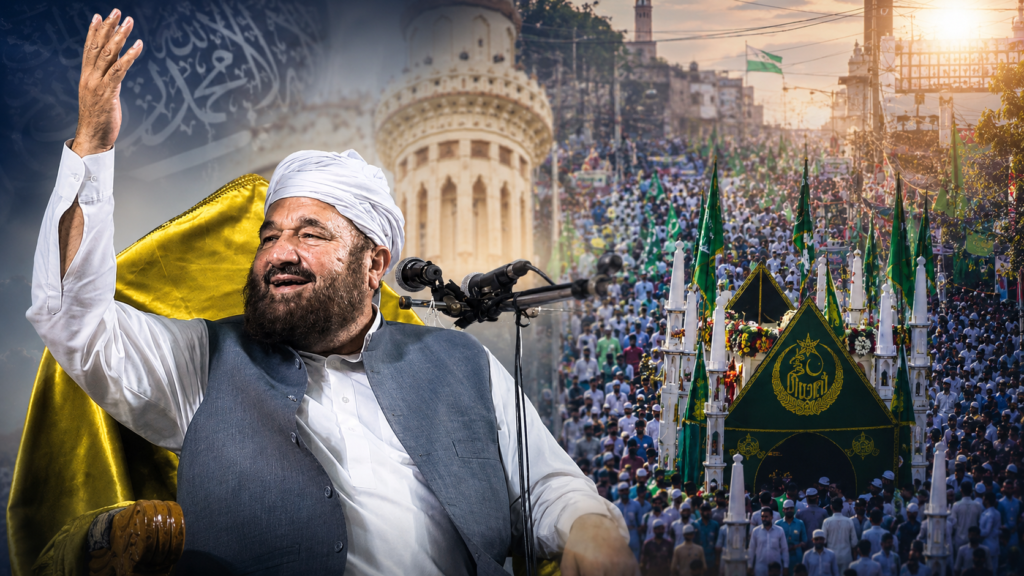
Pakistani religious figure and politician Allama Syed Muhammad Sabir Shah, popularly known as Pir Sabir Shah, is leading this year’s historic Jashne Julus in Chattogram, gathering hundreds of thousands of devotees to one of Bangladesh’s largest religious processions ‘Eid-e-Miladunnabi’.
The 55th Jashne Julus, organised by the Anjuman-e-Rahmania Ahmadia Sunnia Trust, began Wednesday morning from the Alamgir Khanqah-e-Qaderia Syedia Tayebia area beside Jamea Ahmadia Sunnia Kamil Madrasa in Sholashahar.
The procession is passing through major areas of the port city before returning to the Jashne Julus ground near the madrasa, where religious gatherings, Milad, Naat-e-Rasul, prayers and a special dua are being held.
For Chattogram, however, the event is more than an annual religious procession. Over five decades, the Jashne Julus has become deeply associated with the city’s religious and cultural identity, Bestowing to Chattogram’s popular description as the “City of Jashne Julus.”
Who is Pir Sabir Shah?
Born in 1955 in Sirikot, Haripur, in present-day Khyber Pakhtunkhwa, Pakistan, Pir Sabir Shah comes from a prominent Syed religious family associated with the Sirikot spiritual tradition.
His father, Syed Muhammad Tayyab Shah, was a prominent spiritual figure and the son of Allama Syed Ahmad Shah Sirikoti, who is remembered by followers for his religious activities in the Indian subcontinent, including his long association with Bengal and Burma.
According to the biographical account published by the Anjuman-e-Rahmania Ahmadia Sunnia Trust, the Sirikoti spiritual Ancestry became closely connected with religious education and the Qadiri tradition in Bengal.
Pir Sabir Shah received his early education in Sirikot before pursuing higher education in Abbottabad and at the University of Peshawar.
His educational background combined conventional academic studies with Islamic and Arabic learning.
He later became a prominent political figure in Pakistan while continuing his journey with the Sirikot spiritual tradition.
From provincial politics to the Chief Minister’s office
Pir Sabir Shah entered electoral politics in 1985, initially contesting as an independent candidate. He subsequently joined the Muslim League and won provincial elections in 1988, 1990, 1993 and 1997 from his constituency in Haripur.
His most prominent political position came in October 1993, when he became the Chief Minister of the then North-West Frontier Province (NWFP), now known as Khyber Pakhtunkhwa.
Official records of the provincial government list his tenure from October 19/20, 1993, to February 24/25, 1994, making him the province’s 18th chief minister.
He later served as an adviser on political affairs to Prime Minister Nawaz Sharif from 1997 to 1999. He was subsequently elected to the Senate of Pakistan, serving from 2018 until 2024.
His political career has remained closely associated with the Pakistan Muslim League-Nawaz.
A political figure with a spiritual legacy
Unlike many political figures whose public identities are primarily political, Pir Sabir Shah has maintained a parallel identity within the Sirikot spiritual tradition.
He is regarded by followers as one of the Sajjadanashins of Darbar-e-Sirikot, a spiritual institution with longstanding connections to religious networks in Pakistan and Bangladesh.
That connection has made his presence particularly significant in Chattogram, where his family has had a historical relationship with the development of the city’s Sunni religious institutions.
His father, Allama Syed Muhammad Tayyab Shah, played a major role in the religious network associated with the Sirikoti tradition in Bangladesh. The Anjuman Trust traces its institutional history to this Ancestry and its activities in Chattogram.
How Chattogram became the “City of Jashne Julus”
The modern Jashne Julus tradition in Chattogram dates back to 1974, when a procession ‘Eid-e-Miladunnabi’ was organised under the guidance of Allama Syed Muhammad Tayyab Shah and the Anjuman-e-Rahmania Ahmadia Sunnia Trust. Since then, the procession has grown dramatically in scale.
The tradition has transformed the streets of Chattogram every year around Eid-e-Miladunnabi. Religious banners, decorations, flags, devotional recitations, Naat and gatherings fill major parts of the city as participants arrive from different parts of Bangladesh.
Why Pir Sabir Shah’s presence matters this year
Pir Sabir Shah’s role in the 2026 procession carries particular significance because of his family’s historical connection to the Jashne Julus tradition.
According to organisers, he is leading the 55th Jashne Julus this year, with Shahzada Syed Muhammad Qasem Shah and Shahzada Syed Muhammad Aqib Shah also participating.
His visit has therefore brought together two dimensions of his public identity: the former Pakistani provincial chief minister and politician, and the spiritual figure associated with the Sirikot tradition.
For Chattogram’s devotees, his appearance also represents a continuation of the relationship between the Sirikot spiritual family and the city’s Jashne Julus movement that began more than five decades ago.
A procession that has become part of Chattogram’s identity
The Jashne Julus has grown from a relatively modest religious procession in 1974 into a massive annual gathering involving participants from across Bangladesh.
The city’s streets become the setting for an expression of religious devotion, while the procession has also become an important part of Chattogram’s public cultural landscape.
On August 26, 2026, as Pir Sabir Shah leads the 55th edition through the streets of the port city, the procession once again demonstrates why Chattogram has acquired its distinctive reputation as the “City of Jashne Julus.”
The event is not simply a single day’s procession. For its organisers and millions of followers, it represents a religious tradition that has been built over more than five decades and continues to connect Chattogram with the wider spiritual network of the Sirikot tradition.