
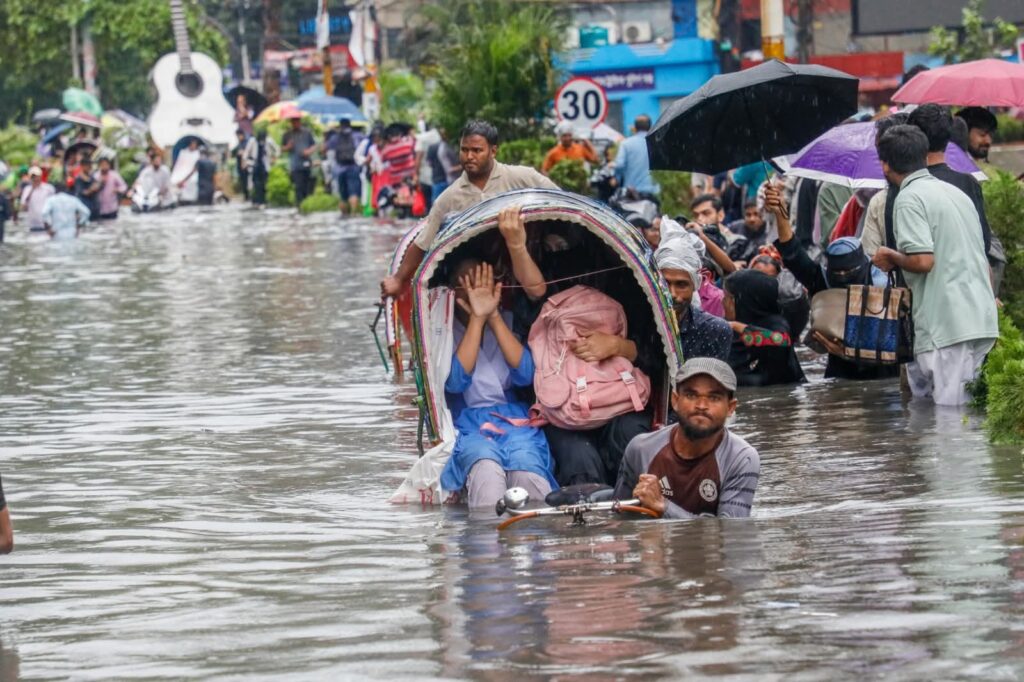
For decades, the residents of Chattogram, Bangladesh’s primary port city, have lived under the shadow of a seasonal “curse”: chronic waterlogging. Despite a staggering investment of over 14,399 crore BDT (approximately $1.2 billion) across four massive infrastructure projects, the reality on the ground remains stubbornly unchanged.
On Tuesday, a mere four-hour downpour offered a grim rebuttal to official claims of progress. Major thoroughfares and narrow alleys from Muradpur to Agrabad were submerged under three to four feet of water, transforming the city’s commercial arteries into canals and inflicting millions in damages to warehouses and retail stock.
The disconnect between bureaucratic optimism and the lived experience of the city’s six million residents has sparked a pointed question: Where exactly did the money go?
A Fragmented Offensive
The city’s battle against the rising tides is currently split among three distinct agencies—the Chattogram Development Authority (CDA), the Chattogram City Corporation (CCC), and the Water Development Board (WDB). While these bodies oversee four “mega-projects” aimed at revitalizing 36 canals and installing sophisticated regulators, the coordination between them appears as murky as the floodwaters themselves.
The largest of these efforts, a $730 million project managed by the CDA, is tasked with canal re-excavation and the installation of pump houses. Project officials insist that work is nearing its final stage, with a definitive completion date set for June 2026.
However, on Tuesday, many of the critical pump houses reportedly failed to operate at full capacity, leaving the water with nowhere to go.
In neighborhoods like Bahaddarhat, the irony is particularly sharp. A dedicated $115 million canal project, designed specifically to drain this flood-prone zone, missed its June 2024 deadline and is only now in its “final stages.” Despite the investment, Bahaddarhat remained one of the most heavily inundated areas during the latest rains.
Structural Failures and ‘Artificial Floods’
Urban planners and experts point to a systemic failure in the city’s internal plumbing. While the CDA focuses on the primary canals, the CCC’s smaller tertiary drains remain choked with silt and polythene waste. This creates a bottleneck effect; even if the main canals are clear, the rainwater never reaches them.
”The crisis is three-fold,” explained one local urban specialist. “Beyond the lack of inter-agency coordination, the rapid siltation from hill-cutting and the physical obstructions—such as low-lying bridges and utility pipes running through the canals—have turned these multi-million dollar projects into expensive cul-de-sacs.”
Furthermore, a $235 million project aimed at blocking tidal surges from the Karnaphuli River has inadvertently created “artificial floods.” By successfully keeping the river out, the system has also trapped rainwater inside the city’s flawed drainage network.
The Looming 2026 Deadline
As the June 2026 deadline for the final completion of all projects approaches, the stakes have shifted from engineering to politics. Official rhetoric remains focused on “finishing touches” and “technical complexities,” promising a permanent solution by next year.
Yet, for the shopkeepers in Chakbazar baling water out of their storefronts and the commuters wading through waist-deep filth, the promises ring hollow. When a 140 billion BDT defense is defeated by a four-hour storm, the issue ceases to be a natural disaster and becomes a crisis of governance.
Whether the “New Spring” of infrastructure will finally dry the streets of Chattogram remains to be seen, but for now, the city continues to wait for a return on its massive investment.