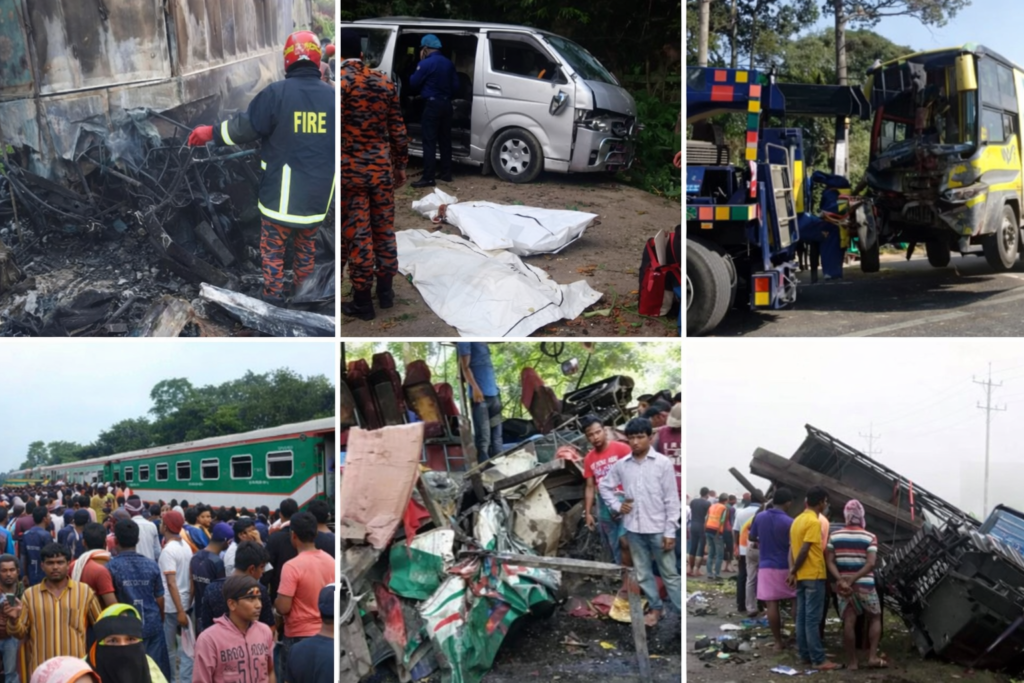
Each day, people leave their homes expecting to return safely. Yet many never do. Routine journeys are increasingly ending in tragedy, with victims either losing their lives or suffering severe, permanent injuries. What was once considered occasional misfortune has now escalated into a persistent national crisis, as road accidents continue to rise at an alarming rate across Bangladesh.
The situation has steadily worsened. From 2025 into 2026, road accidents have continued to rise, surpassing previous years. In 2025, the country recorded higher numbers than in 2024, breaking earlier records. According to the Bangladesh Jatri Kalyan Samity, road accidents increased by 6.94 percent in 2025, while deaths rose by 5.79 percent compared to the previous year.
The trend has continued into 2026, raising further concern. Data from March alone shows how serious the situation has become. According to the Road Safety Foundation, there were 576 road accidents across the country in that month. These incidents killed 532 people and injured 2,221 others.
The report was prepared using information from national newspapers, online news portals, electronic media, and the foundation’s own records.
Motorcycle-related incidents accounted for a significant portion of fatalities. Out of the total deaths, 204 victims—38.34 percent—were motorcyclists or their passengers. Motorcycle accidents alone made up 38.02 percent of total crashes.
During the same period, other modes of transport also contributed to the casualty figures. There were 14 waterway accidents, resulting in 12 deaths, 27 injuries, and three missing persons. Additionally, 48 railway accidents led to 67 deaths and 224 injuries.
A closer look at the data shows how widespread the risk is. Among those killed, 204 were motorcyclists, 45 were bus passengers, and 28 were from trucks, pickups, or tractors. Private cars and microbuses accounted for 46 deaths, while 94 victims were passengers of three-wheelers such as auto-rickshaws and CNGs. Locally made vehicles like nasimon, pakhi vans, votvotis, tomtoms, and Mahindras accounted for 23 deaths, while 13 bicyclists also lost their lives.
Regionally, the impact of road accidents varied across divisions. The Dhaka division recorded 21.87 percent of total accidents and 25.75 percent of deaths. Chattogram followed closely with 21.70 percent of accidents and 19.17 percent of fatalities. Rajshahi reported 13.19 percent of accidents and 12.40 percent of deaths, while Khulna accounted for 13.54 percent of accidents and 13.53 percent of fatalities. Other divisions, including Barishal, Sylhet, Rangpur, and Mymensingh, also experienced notable shares of accidents and casualties.
Experts and analysts point to multiple factors behind the rising toll. According to the Road Safety Foundation and the Bangladesh Jatri Kalyan Samity, unskilled and fatigued drivers remain a leading cause. Weaknesses in the licensing system and long hours of driving without rest have significantly increased risks.
Faulty and unfit vehicles continue to operate freely on highways, contributing to many accidents. The presence of unauthorized slow-moving vehicles such as nasimon, karimon, votvoti, and easy bikes on national highways has further intensified the danger.
Poor road management and weak enforcement of traffic laws have created a culture of disregard for safety regulations. Violations of traffic rules often go unchecked, making roads even more unsafe.
Corruption and extortion within the transport sector further complicate the situation, limiting effective oversight and worsening safety conditions.
As accidents and fatalities continue to rise, one question remains: when will this deadly toll on the roads finally come to an end?
By Pritam Sarkar